Notice. New forum software under development. It's going to miss a few functions and look a bit ugly for a while, but I'm working on it full time now as the old forum was too unstable. Couple days, all good. If you notice any issues, please contact me.
PhenixRising Guru Joined: 07/11/2023 Location: United KingdomPosts: 2100
Posted: 09:15pm 06 Apr 2026
Copy link to clipboard
Print this post
Grogster Admin Group Joined: 31/12/2012 Location: New ZealandPosts: 10073
Posted: 12:40am 07 Apr 2026
Copy link to clipboard
Print this post
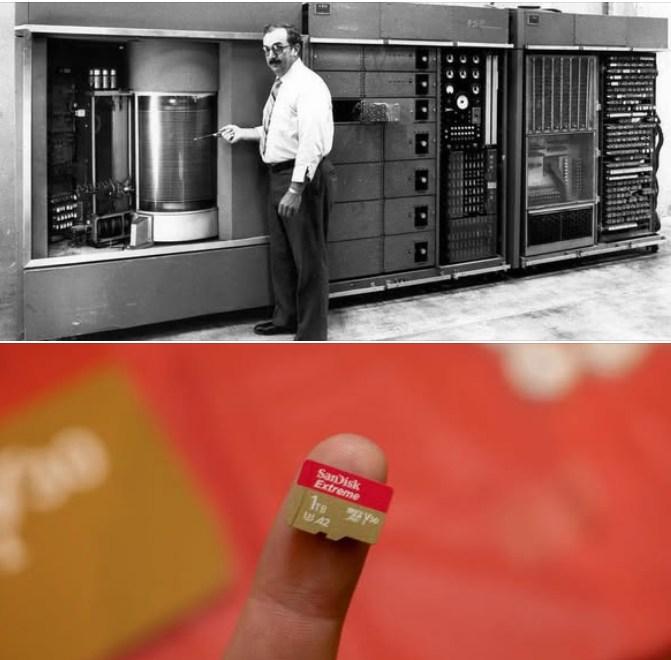
...and 3.75MB would have seemed like such a humongous amount of space back then too!
I find these kinds of comparison really interesting - seeing how far storage capacity has come and how tiny it is now for the amount of storage you get.
And the price is USUALLY very good per MB. Not QUITE so good these daze cos of the RAM shortages pushing up prices beyond belief, but HDD's and flash memory still seem to be reasonably priced and not as insane as the RAM stick prices are.Smoke makes things work. When the smoke gets out, it stops!
JohnS Guru Joined: 18/11/2011 Location: United KingdomPosts: 4391
Posted: 06:42am 07 Apr 2026
Copy link to clipboard
Print this post
I don't think I even knew how much memory the few mainframes had that I used (but "only" 50+ years ago).
I managed to get occasional access to a quite new minicomputer and it had a disk drive (in this case a fixed disk). It really helped!
But it was... 64K (words, I suspect, which were 16-bit). Actual memory (RAM) was smaller, 28Kw.
I don't know what it cost but it got an air-conditioned room :) something I think pretty much only computers and hospital operating theatres got back then (here, England).
1TB? Luxury! We used to dream of...
John
Mixtel90 Guru Joined: 05/10/2019 Location: United KingdomPosts: 9238
Posted: 06:45am 07 Apr 2026
Copy link to clipboard
Print this post
The drum store is so pretty though! And the micro SD is, providing you don't lose it as it's ejected across the room by the socket attempting to impart earth orbit velocity, so very boring.Mick
DigitalDreams Regular Member Joined: 03/05/2025 Location: United KingdomPosts: 65
Posted: 06:54pm 07 Apr 2026
Copy link to clipboard
Print this post
My first computer had 256 BYTES of ram lol (operating system in 512 BYTES of prom). My old Samsung mobile is running a 2Tb micro-sd card very well...
bfwolf Senior Member Joined: 03/01/2025 Location: GermanyPosts: 258
Posted: 07:35am 08 Apr 2026
Copy link to clipboard
Print this post
3.75 MB of hard drive space was quite large and useful for the time. Back then, magnetic hard drives were primarily used as RAM expansion for "virtual memory" (swap space) and not for installing programs or as mass data storage. RAM was much more precious and scarce at the time. Punched cards, paper tapes, and magnetic tapes were used for mass storage of programs and data, and these offered significantly more storage capacity and were also more cost-effective.
This quickly resulted in large stacks of punched cards, and many rolls of paper tape and magnetic tape.
There was a specific profession at the time: data entry clerk (almost exclusively women). They spent all day punching endless columns of numbers onto punched cards or operating a keyboard connected to a punching machine.
IanT Senior Member Joined: 29/11/2016 Location: United KingdomPosts: 137
Posted: 08:33am 08 Apr 2026
Copy link to clipboard
Print this post
I used to support a large (10 cab) PDP 15 system many years ago.
The PDP15 was an 18 bit system with 'core' (ferrite) memory. It had two 32K word fixed disks, using 30" platters. The moving 'heads' flew over the platter surface at much less than a hairs breadth. If a head 'crashed' it was an eight hour rebuild, that involved carefully waxing the replacement platter before installing it. Everything had to be kept spotless during the rebuild. The last part was where the real skill came in. A flick of the wrist on the platter spindle, just as you powered it up. With luck the heads flew and you were back in business. On a bad day, it was order a new platter and spend another 8-hours rebuilding...
The 15 was all component level repair, made much easier by a "speed" control on the front panel that let you run the machine from a few cycles per second up to full speed. This made scoping some bus/logic problems much easier. There were diagnostic programmes but the final trace was often via short machine code routines (in Octal) designed to exercise one particular area of the logic. Writing them was much better than doing any crossword puzzle and I got paid for it too... :-)
Getting old...
Regards,
IanT
PhenixRising Guru Joined: 07/11/2023 Location: United KingdomPosts: 2100
Posted: 11:05am 08 Apr 2026
Copy link to clipboard
Print this post
I love these stories. Need to visit a computer museum at some point. 👍
Mixtel90 Guru Joined: 05/10/2019 Location: United KingdomPosts: 9238
Posted: 11:53am 08 Apr 2026
Copy link to clipboard
Print this post
I don't know about the photo, but some machines used drum store as their RAM. There were multiple heads per track to increase the access speed. Drum store only disappeared relatively recently (up until the 1980's I think) in some specialist systems.
My nearest computer museum is just outside Wigan but I've never been (it's awkward on the bus). I think it's mainly home computers anyway.Mick
DigitalDreams Regular Member Joined: 03/05/2025 Location: United KingdomPosts: 65
Posted: 12:03pm 11 Apr 2026
Copy link to clipboard
Print this post
Yeah just home computers but well worth a visit !. Enter through the door in the corner of the building near the carpark and go upstairs, not very well signposted at first !
IanT Senior Member Joined: 29/11/2016 Location: United KingdomPosts: 137
Posted: 02:44pm 11 Apr 2026
Copy link to clipboard
Print this post
In case there are any ex-DEC field service engineers out there (and just re-reading my post above) I've made a technical error. The heads were fixed, they didn't move. You read the different disk tracks by switching heads electronically. It was a fast but expensive way to do it but data was just one rotation away...
Later (removable) cartridge disks (e.g. RK08's for the PDP8) had moving heads. As I said, it was a very long time ago and I'm getting old(er) :-(
Regards,
IanT
mozzie Guru Joined: 15/06/2020 Location: AustraliaPosts: 469
Posted: 02:46pm 11 Apr 2026
Copy link to clipboard
Print this post
G'day, The Museum of Computing at Bletchley Park is well worth a visit, only been to the UK once for 8 days but made sure to visit, just over 15 years ago now. Wasn't well known at that point. Amazing what they managed there under wartime conditions.
Some might say the shed here is full of museum exhibits
Regards, Lyle.
Timbergetter Regular Member Joined: 08/10/2018 Location: AustraliaPosts: 58
Posted: 11:50pm 11 Apr 2026
Copy link to clipboard
Print this post
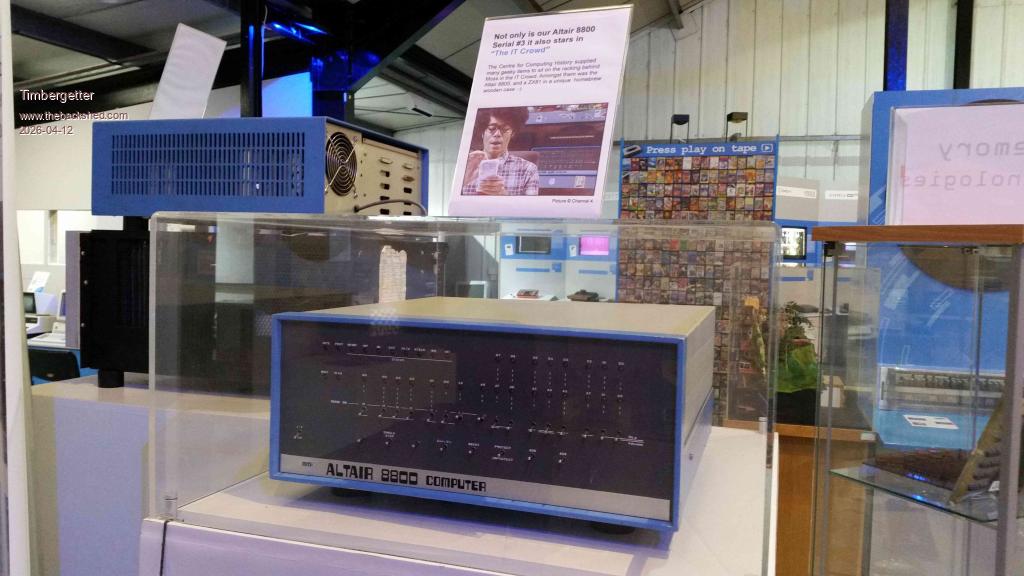
Spotted in the Centre for Computing History Cambridge a few years ago.

 Notice. New forum software under development. It's going to miss a few functions and look a bit ugly for a while, but I'm working on it full time now as the old forum was too unstable. Couple days, all good. If you notice any issues, please contact me.

 Print this post