Notice. New forum software under development. It's going to miss a few functions and look a bit ugly for a while, but I'm working on it full time now as the old forum was too unstable. Couple days, all good. If you notice any issues, please contact me.
thwill Guru Joined: 16/09/2019 Location: United KingdomPosts: 4405
Posted: 09:22am 29 Sep 2026
Copy link to clipboard
Print this post
It's a question of time/opportunity but I'd like to avoid MMB4L and MMB4M from diverging unnecessarily ... for the moment that means I will keep an eye on your work and pull it in as I can. That said, if you go "all Peter" on me and launch into the development stratosphere I'm not making any promises .
hhtg1968 Senior Member Joined: 25/05/2023 Location: GermanyPosts: 232
Posted: 04:33pm 29 Sep 2026
Copy link to clipboard
Print this post
hello. I am the guy who asked for more than 32767 array elements...
I read the further comments. Now I think the compatibility to the picos is more important than my attends to calculate a mass of primes as bench mark for other program languages on my mac... therefore i changed my algorithm. earlier I used an array of Integers to mark non-primes. 1 bit information in one 64-bit integer! how silly! now i use 64 bit in one integer for 64 infos...
For n=2 To ll e=n\64+1 b=n-((e-1)*64) If Bit(z(e),b)=0 Then ' here I am testing the n-th bit in the array z(), not the n-th array-element For p=n*n To l Step n e=p\64+1 b=p-((e-1)*64) Bit(z(e),b)=1 Next EndIf Next
all remaining 0-bits in the array represent a prime.
because of my programming on 8-bit systems with 64k memory I use short names for the variables, sorry.
this is the "sieve of Eratosthenes". in this changed algorithm I use every bit. so I can check the primes until 32767*64=2.097.088. that is enough.
and... the roadmap is fine.
thwill Guru Joined: 16/09/2019 Location: United KingdomPosts: 4405
Posted: 05:08pm 29 Sep 2026
Copy link to clipboard
Print this post
Don't quote me on this but I think the PicoMite might allow more than 32767 array elements. MMB4L started as a fork of the MicroMite / MMBasic for DOS code (not CMM2 or PicoMite) and still has some (probably unnecessarily) limits inherited from that.
I'm currently researching the respective limits, but I can't say for certain whether they are accurate. As Thomas mentioned, MMB4L, and therefore MMB4M, is based on MicroMite / MMBasic for DOS code, which is why those limits apply.
My current plan is to use the limits of the Windows version. What's still open is whether the simulate parameter should also use the limits of the respective hardware. I need to check how much effort that would take. It would require an extension so that RP2040 and PSRAM can be distinguished there as well. The advantage is that the limits would be "comparable". Since the internal structures in MMB4x differ, though, this would only be an approximation.
This also shows once again that all platforms except the RP2040 (probably because of its tight RAM) are 32-bit, with the exception of Linux and Mac.
Volhout Guru Joined: 05/03/2018 Location: NetherlandsPosts: 6151
Posted: 07:41am 30 Sep 2026
Copy link to clipboard
Print this post
Hi Tom,
Thanks for your overview Looks like the RP2040 is the odd fish (probably similar to CMM1/MM), and MMB4L was made compatible.
So you might loose some backward compatibility to 2040. Not a big deal. IF you design a program that requires such large arrays it will (memory wise) never run on a 2040. Also since MMBasic never supported PSRAM on 2040.
matherp Guru Joined: 11/12/2012 Location: United KingdomPosts: 11934
Posted: 07:54am 30 Sep 2026
Copy link to clipboard
Print this post
MMbasic historically had always used 16 bits for the dimensions and on the PIC32 (MM2) the memory available made it impossible to define an array bigger than even 10000 let alone 32767. This all changed with the CMM2 where the available memory made arrays much bigger than 32767 available so I changed the dimension array from 16 to 32-bits. Doing this makes bigger arrays available but also uses more memory for the table that holds the variable definitions. The RP2040 is memory constrained so it made sense to revert back to 16-bits to reduce the size of the variable definition table since the biggest array on the rp2040 PICO possible would be around 16000 even if you used every bit of memory. The RP2350 with PSRAM changed the equation again allowing much bigger arrays again. There is no MMBasic code compatibility issue. All this is completely transparent to the Basic user. The only issue comes if the user needs a very big array in which case their code could never run on a rp2040 or MM2 under any circumstances.
This version adds many commands from PicoMite V6.04, including BIT() and BYTE(), DO UNTIL, TRIM$, commands that work on whole arrays, AES encryption, and Base64.
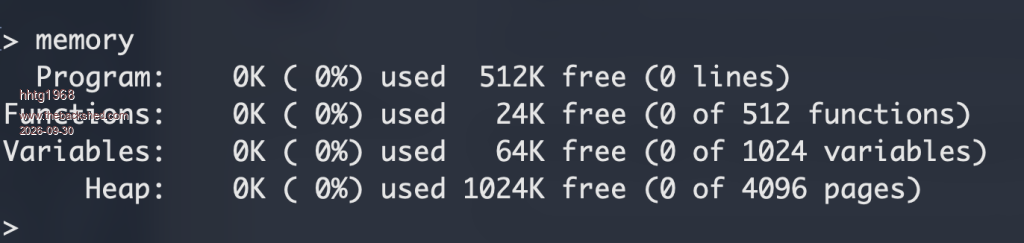
Most limits now match or exceed those of MMBasic for Windows: 128 MB for variables, arrays, and strings, a 1 MB program size, and arrays can have more than 32767 elements per dimension.
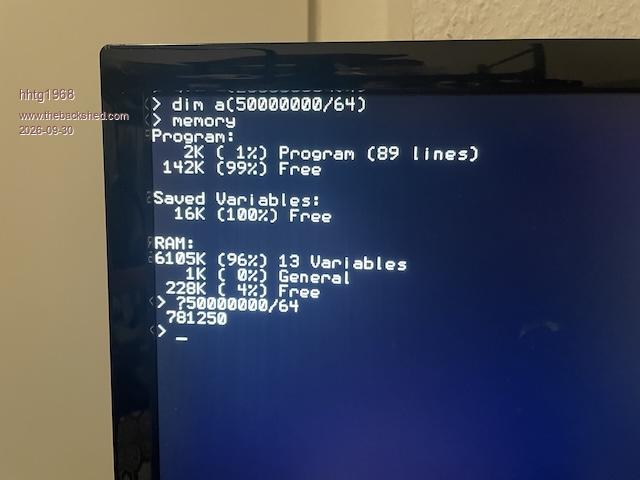
@hhtg1968, that settles both of your recent questions: BIT() is now available, and DIM a(781250) runs.
MID$ as a command, TIMER, END, and BOUND now behave as they do on PicoMite. You'll find more in the changelog.
Please test it and let me know if something doesn't work that the changelog says should.MMBasic for Mac
hhtg1968 Senior Member Joined: 25/05/2023 Location: GermanyPosts: 232

 Notice. New forum software under development. It's going to miss a few functions and look a bit ugly for a while, but I'm working on it full time now as the old forum was too unstable. Couple days, all good. If you notice any issues, please contact me.


 Print this post
 .
.