Notice. New forum software under development. It's going to miss a few functions and look a bit ugly for a while, but I'm working on it full time now as the old forum was too unstable. Couple days, all good. If you notice any issues, please contact me.
homa Guru Joined: 05/11/2021 Location: GermanyPosts: 723
Posted: 09:00pm 11 May 2026
Copy link to clipboard
Print this post
OK, but where exactly? Either I've got a blind spot or my English isn't up to scratch. I’ve only found the prototype board with that name, but I can’t see any confirmation in the text that the name ‘mmbasic’ was chosen for that reason. Edited 2026-05-12 07:02 by homa
DaveJacko Senior Member Joined: 25/07/2019 Location: United KingdomPosts: 107
Posted: 09:17pm 11 May 2026
Copy link to clipboard
Print this post
I know the story, but "Marvel of this Millenium" basic suits me, thanks to all mmbasic contributors, love itTry swapping 2 and 3 over
TassyJim Guru Joined: 07/08/2011 Location: AustraliaPosts: 6626
robert.rozee Guru Joined: 31/12/2012 Location: New ZealandPosts: 2552
Posted: 04:36am 12 May 2026
Copy link to clipboard
Print this post
as Jim suggests, when Geoff originally wrote mmbasic (around 2011) the 'MM' stood for "MaxiMite". those MaxiMites had mmbasic running on a PIC32MX695 (or MX795) microcontroller: https://geoffg.net/MonoMaximiteDesign.html
it was a machine with 128k or RAM that generated a monochrome composite or VGA video output, and connected to a PS/2 keyboard and SD card. BASIC programs could be stored in on-chip flash (hence the SD card was optional), and as i recall were loaded into RAM to be run. following the original (monochrome) MaxiMite there was also a Colour MaxiMite released that could generate colour VGA output. all were based on the same PIC32MX695 (or MX795) chip. there was one hardware variant called the "Mini MaxiMite" for embedded usage that had pretty much just the PIC32MX695 (or MX795) on a small rectangular board intended for being embedded in projects. note that the MX695/795 also had on-chip USB support, and all variants could also be tethered back to a PC running a VT100 terminal emulator acting as a virtual console.
these machines were making the "Maximum" use of a single chip to recreate the 1980's computing experience!
later on, Geoff released a reworked variant of mmbasic that ran on the considerably smaller PIC32MX150 (and later MX170), giving rise to the MicroMite family: https://geoffg.net/micromite.html
the MicroMite had no SD card or video support, and ran BASIC programs directly from on-chip flash memory (as opposed to loading into RAM first). the chip used was the 28-pin DIP version of the PIC32MX150 (and later MX170). at this point the mmbasic they ran was now referred to as "MicroMite Basic". for a console they exclusively talked to a TTL/serial VT100 terminal - unlike the MX695/795, the MX150/170 chips had no USB hardware support on-chip.
following on there were 'bigger' variants of the MicroMite that used a PIC32MX470 chip and later other PIC32s: https://geoffg.net/Explore64.html essentially, these bigger variants brought back in support for SD card, video, and keyboard. it was around this time that Peter Mather became involved with porting mmbasic to newer chips that were available, including the CMM2 that used an ST chip.
when COVID arrived, chip supplies dried up, and for several years about the only chip that one could readily obtain was the RP2040 - a fortunate arrival on the scene just before lockdowns hit... after some consternation over the 2040's limited abilities Peter finally managed to shoe-horn mmbasic into it, giving rise to the PicoMite. i often wonder if the version of mmbasic that the pico chips run should not be renamed to "PicoMite Basic", ie PMbasic.
please do chip in if anyone has a better memory of events that i do. i may well have got some of the details muddled!
cheers, rob :-) Edited 2026-05-12 21:08 by robert.rozee
homa Guru Joined: 05/11/2021 Location: GermanyPosts: 723
Posted: 05:37am 12 May 2026
Copy link to clipboard
Print this post
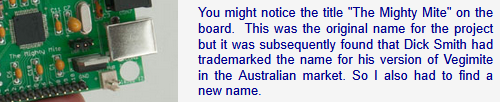
I was referring to this sentence and image:
And I wondered if that's originally where the 'mm' comes from.
So if 'mm' still works, that's fine. That is what I gather from the timeline of events.
But Geoff is the only one who can explain that and confirm it.
JohnS Guru Joined: 18/11/2011 Location: United KingdomPosts: 4391
Posted: 06:49am 12 May 2026
Copy link to clipboard
Print this post
rob - good summary!
The PIC32 versions were amazing, doing so much from such a chip (and a great chip it is/was, great features, rock solid).
(Not knocking the other chips, they all have their places.)
John Edited 2026-05-12 16:50 by JohnS
Mixtel90 Guru Joined: 05/10/2019 Location: United KingdomPosts: 9238
Posted: 07:21am 12 May 2026
Copy link to clipboard
Print this post
Compared to the Microchip chips the RP240 is seriously cheap silicon. IIRC Raspberry Pi used relatively old chip technology deliberately so that they could use the cheapest fabs. Bulk price was only $0.70 per chip bought direct even them - might be less now. The RP2350 is only $0.80 in bulk and that has a couple of RISC-V cores thrown in! :) . Edited 2026-05-12 17:22 by Mixtel90Mick
Geoffg Guru Joined: 06/06/2011 Location: AustraliaPosts: 3369
Posted: 08:11am 13 May 2026
Copy link to clipboard
Print this post
Good summary Rob (Rob has been around since the early days).
As Rob said, the MM in MMBasic originally stood for MaxiMite but these days that is not important. MMBasic has been ported to so many platforms that it would not make sense to keep renaming it.
homa Guru Joined: 05/11/2021 Location: GermanyPosts: 723
Posted: 07:30pm 13 May 2026
Copy link to clipboard
Print this post
Thanks, Geoff.
I don't want to rename it either. I just assumed there was a generic name behind the abbreviation. Maxi, Mighty, Multi — whatever. Let's keep it short and sweet with 'mmbasic'!

 Notice. New forum software under development. It's going to miss a few functions and look a bit ugly for a while, but I'm working on it full time now as the old forum was too unstable. Couple days, all good. If you notice any issues, please contact me.


 Print this post